Tuesday, 4 May 2010

April 24 Commemoration Reports from Turkey (including Welsh contribution)‏

The Armenian Weekly

Mouradian: The Sound of Footsteps on April 24 in Istanbul

by Khatchig Mouradian

If you were one of the few hundred people in Istanbul that publicly commemorated

the Armenian Genocide on April 24, 2010, you probably heard the sound of footsteps.

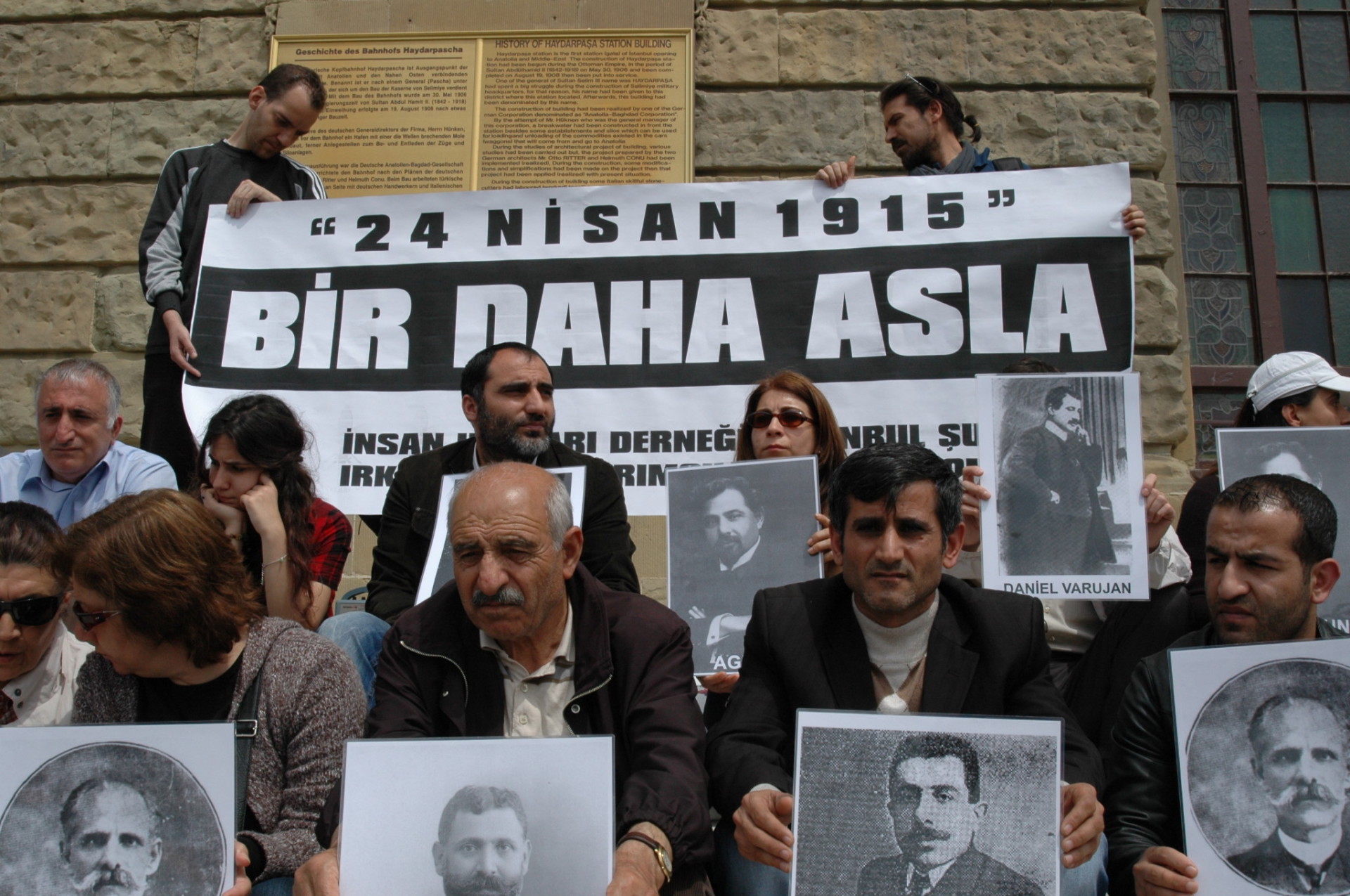
Activists holding photos of murdered Armenian intellectuals during the Genocide commemoration at the Haydarpasha Station in Istanbul. (Photo by Mujgan Arpat)

I am not referring to the footsteps of the defiant Turks, Kurds, and Armenians who gathered

at open-air commemoration events. Nor am I referring to the footsteps of counter-demonstrators

holding placards that read, “The Armenian Genocide is an imperialist lie,” and yelling,

“Death to the Armenian Diaspora.”

Daniel Varoujan—the prominent Armenian poet who was arrested on April 24, 1915 and eventually

killed, just like hundreds of his fellow Armenian intellectuals—says in one of his poems that he can

“hear the footsteps of a rose-flooded dawn” of victory. From a distance of 95 years, you probably

were hearing, dear friend, the sound of the very same footsteps.

I know I was.

And the sounds of footsteps were gradually becoming louder.

I was hearing those footsteps as I watched Kurdish women hold pictures of their “disappeared” sons

and pictures of Armenian intellectuals murdered in 1915. I was hearing those footsteps as I was at the

commemoration at the Haydarpasha Station. I was hearing those footsteps as I was delivering a genocide

commemoration lecture in Beyoglu.

And I was hearing those footsteps during the vigil on Taksim Square.

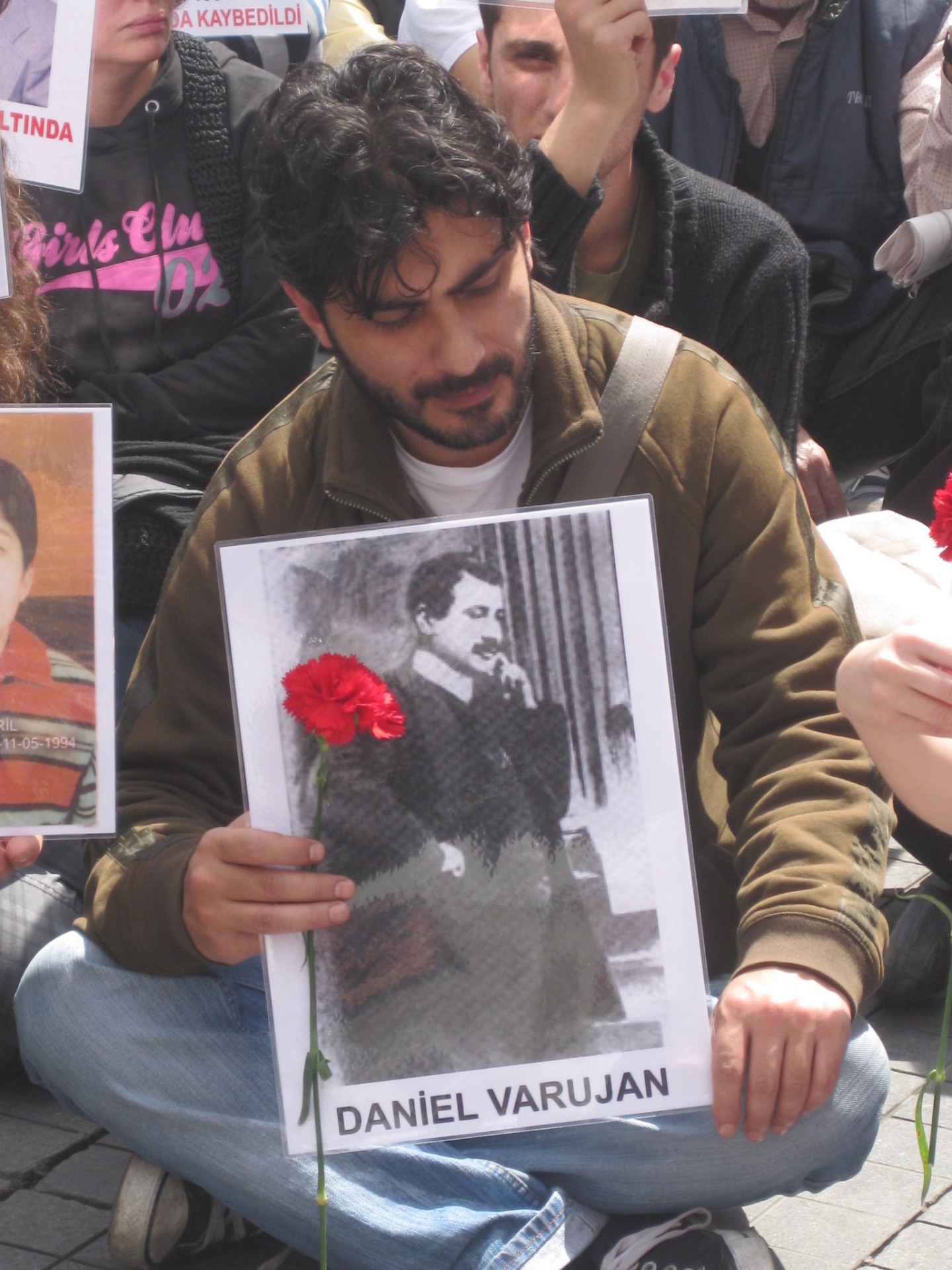
An activist holding Varoujan's picture at one of the commemoration events in Istanbul on April 24. (Photo by Khatchig Mouradian)

The footsteps of Varoujan’s rose-flooded dawn of victory.

The victory of memory over amnesia, affirmation over denial, and action over indifference.

On April 24, 2010, I was in Istanbul for you, Varoujan. For all that your work, your life, and your murder

means to me. And I, too, heard the footsteps.

The Turkish version of this article appeared in this week’s issue of Agos.

Speech to the Ankara 24th-25th April Conference
by Eilian Williams ,
Solidarity with the Victims of All Genocides
and on behalf of the Welsh Centre for International Affairs
An Alternative Way for Anatolia-
the Restoration of "Turkish" Armenia
I come here today as one who is conscious of the Celtic blood that, through the Galatians,
runs in the veins of many Anatolians. Indeed it is the cultural diversity of Anatolia that has
always been its glory. I bring with me the perspective of the small nations of Europe who are
conscious that genocidal instincts was a common feature of all colonial powers, whether British,
Russian or Ottoman. The recent Genocide Recognition resolutions of the Basque and
Catalonian parliaments, as well as the Recognition accorded in Wales and by the majority of
UK Parliament members from Wales, Scotland and Northern Ireland cannot be ignored by
Turkey: these nations have no political interests in antagonizing Turkey but do have long ethical
democratic traditions
The issue of Reparations for the Genocide has a sound base in Natural Justice, and the
whole issue of future Armenian-Turkish relations cannot be divorced from Reparations. Let us
not forget though the culpability of the former Great Powers, especially Britain, in legitimizing the
award to Turkey of her present borders following the successful genocide of her Armenian
and Syriac/Assyrian population . Turkey's entry into the European Union will undoubtedly mean
that the European Union assumes a great part of Turkey's liability for reparations. This offers the
prospect of diverting part of the potential benefits of EU Membership into the "Great Idea" of a
Restoration of Western Armenia that is to revert back to the position when people of many
ethnicities, languages and cultures could live alongside each other before the Turkification of the
area destroyed this rich-in-diversity area inhabited by Armenians, Assyrians/Syriacs, Greeks,
Kurds and Turks.
The denial of the 1915 Genocide by Turkey is contradicted by another of its contentions, that
there is no Turkish Armenia Turkey cannot deny the Genocide and at the same time claim that
Western Armenia no longer exists. I propose that this is another possible path for Turkey, by
which it may avoid a substantial transfer of land . We are talking not only about the Restoration of
the Armenian and Syriac Cultural heritage of Western Armenia but also Restoration of a People
to their proper identity. Some of the two million Armenians and Syriacs lost from Anatolia in 1915
can be recovered today if Turkey creates the right conditions for "Crypto"-Armenians, and "Crypto"
Assyrians to return to their true identities. It is still dangerous for this to happen in many parts of
Turkey. To start with they must be allowed to state their identities as they wish in a future census
eg Muslim Armenian, or Turkified Armenian or Kurdified Armenian or Assyrian. The Armenian
language must be offered officially in large areas of Van, Bitlis, Erzerum, Sivas etc. Further a
number of Armenian and Syriac Churches must be quickly restored and used. We witness no
quick developments in the restoration of Tasharon Church in Malatya. The restoration and
reopening of this Church in memory of Hrant Dink would give encouragement for many to return
to their true identities. Similarly the Syriac language must be taught and given official recognition
and support.
In parallel with this, people whose ancestors were forcibly converted but who know their origins
must be allowed to revert back to their normal everyday life and traditions.This includes Turkified
or Kurdified Armenians and Assyrians,and this may lead to a stronger, more vibrant region.
It is recognized that this process of Return and Restoration will be a painful process for many,
Churches should be allowed to open their doors to those who wish to restore their original faith,
and this process must be seen by the state and religious authorities as acceptable. It will only occur
slowly at first If they are helped and given encouragement, then perhaps their children will one day
return. Muslim authorities could recognize publicly that the forced conversions of 1915 was a crime,
and that the descendants should be encouraged to assume their rightful identity without fear of
retribution.
I will never forget the kindness shown to me by Muslim Armenians and coming to Turkey for
the first time has changed my life. Since Hrant's death, I have shaken the hands of sympathetic
ethnic Turks for the first time and I believe that (in Hrant's words),my "poisoned blood" towards
Turks is being cleansed.
For the rest,, "pure" Turks and others who are half-, quarter- or one-eighth Armenian, what are they
to do? Was the cry "Ermeni Hepimiz " only for Hrant's funeral? Or should we take it literally? We
can all search for partial Armenian identity, whether by learning the language or by embracing the
beauty of Christianity, the religion of forgiveness.
There is a beautiful saying in Armenian, " Tsavotsanem " ("I take your pain") . One cannot say it
without being close to the soul of the recipient. By taking one of the above steps perhaps Armenians
will allow us all one day to say "Tsavotsanem"

(to grasp the extent and vibrancy of Armenian and other people's lives before the Armenian Genocide,

go along to the Armenian Institute/SOAS exhibition at the Brunei Gallery.

It's a must))

Armenian contribution to Ottoman Empire/Turkey

http://www.youtube.com/watch?v=D7fh9K0jJKk
[Fwd: Election on 6 May 2010 Voting is ever so critical!]‏

Dear Friends,
Those of you who live in UK please provide a moment to read Mr. Sarkissian's note related to the upcoming elections.
Thank you for your attention to this matter.
Dikran Abrahamian BA MD
www.keghart.com

Dear friend,
Could I ask you please to consider my request below as a matter of high priority.
If you don't live in Ealing, you may still consider my request or forward it to your friends and family who reside in Ealing.
You may be aware that the Chief Executive Officer of Ealing Council (a Conservative authority) has opposed to the use of the term Genocide on the plaque for the memorial tree planted in Ealing on 17 April 2010, by the ACCC, to pay homage to the memory of 1,500,000 victims of the Armenian Genocide.
This is not acceptable and the loyal Armenian Community of Ealing can not tolerate such a discriminative approach by the COE of a Conservative Council. Our Local Council should not be allowed to deny our history.
I would like to urge you please to vote Labour this Thursday 06 May 2010.
It is very important to make your voice heard by voting.
Labour candidates promise to officially recognise the Armenian Genocide at Ealing Council and erect a worthy memorial for the Armenian Genocide.
Please vote for Labour candidates.
(Please also refer to attached letter).

With best wishes

Raffi Sarkissian


ARMENIAN INSTITUTE

THEMED LECTURES

WESTERN ARMENIAN LITERATURE AT THE END OF THE OTTOMAN EMPIRE

Dr Laurent Mignon & Dr Victoria Rowe

Sunday, 9 May 2010, at 7:00 pm

N Gulbenkian Hall, Iverna Gardens, W8 6TP

(Tube: High Street Kensington)

Admission: £3; Free for Friends of Armenian Institute

Lost in Transliteration: The Armeno–Turkish novel and Turkish Literary Historiography

Dr Mignon will talk about the role of the Armeno–Turkish novel in the development of modern Turkish literature and discuss its place in official Turkish literary historiography.

Women Writing the Ottoman Armenian Experience 100 Years Ago

Dr Rowe will explore cosmopolitanism, connection and constitutionalism in Ottoman Armenian life 100 years ago in contemporaneous novels, plays, short stories and memoirs by authors such as Srpouhi Dussap, Marie Beylerian, Zabel Yesayan, Inga Nalbandian and Berjouhi Barseghian. Literary texts by these women offer unique insights into the private lives and struggles of Ottoman Armenian women and men at a time of explosive cultural and political tumult.

Wine and snacks to follow the lectures.

Dr Laurent Mignon is Departmental Lecturer in Turkish at the University of Oxford. His areas of research include 19th and 20th century Turkish literature and minority literature.

Dr Victoria Rowe specializes in Armenian literary history and women’s writing. She is the author of A History of Armenian Women’s Writing, 1880–1922 and has translated into English short stories, poems and plays by Inga Nalbandian, Shushanik Kurghinian and Aleksandr Shirvanzadé.

MY DEAR BROTHER: ARMENIAN LIFE IN TURKEY 100 YEARS AGO

Project supported by the Heritage Lottery Fund

The Armenian Institute is grateful to the Heritage Lottery Fund for supporting this and other forthcoming events under the project: My Dear Brother: Armenian Life in Turkey 100 Years Ago.

The Armenian Institute is a London-based registered charity dedicated to making Armenian culture and history a living experience, through innovative programmes, educational resources, workshops, exhibits and performances. Its work is supported by friends, patrons and voluntary donations. For more information about the Armenian Institute or to find out about supporting the important work of the Institute, please visit our website at www.armenianinstitute.org.uk, contact us at info@armenianinstitute.org.uk or call 020 7978 9104. If you would like your email address to be removed from the list, please send an email with "remove" in the subject heading to info@armenianinstitute.org.uk.


Monday, 3 May 2010

95-rt Ankam Abril 24‏

ARTICLE BY HAGOP MARDIROSSIAN
LOS ANGELES, U.S.A.
ՅՕԴՈՒԱԾ ՅԱԿՈԲ ՄԱՐՏԻՐՈՍԵԱՆԷՆ
ԼՈՍ ԱՆՃԵԼԸՍ, Մ. ՆԱՀԱՆԳՆԵՐ

Our Organizations Should Learn to Walk the Talk‏

Content: 2 May 2010
You might find other articles at www.keghart.com that interest you. Please visit the poll question located at the right upper corner of the Home page.
If you would like your name to be deleted from the mailing list please respond by writing "remove" in the subject line.

Thank you for your attention!

Armenian News

ARMENIA AGAIN AMONG 'NOT FREE' IN FREEDOM HOUSE REPORT
Tert.am
16:00 ~U 29.04.10

A Washington-based international non-governmental organization Freedom
House has released its 2010 report on freedom of press in which the
countries are classified as "free," "partially free" and "not free."

Armenia is among those states "not free" side by side with Cameroon,
Côte d'Ivoire, Marroco, Katar, Azerbaïdjan and Iran.

However, Freedom House has registered some improvements in Armenia.

"We see a reduction of censorship in Armenia and Moldova, as well as
a decrease of control over news reports," reads the report.

Though Armenia has improved the situation over freedom of media by
two points (now it is 66 points while last year it was 68), it has
nevertheless remained in the same group.

Of the three countries in the South Caucasus only Georgia has been
included among "partially free" states.

The report includes 196 states of which 35% have a "free" press, 33%
has "partially free" press and 32% - "not free."

The list of the states that have "free" press are Finland, Iceland,
Norway, Sweden, Denmark, Belgium, Luxembourg, Andorra, Swiss.

Among "not free" states are Iran, Belarus, Uzbekistan, Cuba, Eritrea,
Libya, Burma, Turkmenistan and North Korea.


HEAD OF ARMENIAN CHURCH PAYS LANDMARK VISIT TO TRADITIONAL
ENEMY AZERBAIJAN
BYLINE: Lilit Gevorgyan
World Markets Research Centre
Global Insight
April 28 2010

The leader of Armenian Apostolic Church, Catholicos Garegin II, made
an unprecedented trip to neighbouring Azerbaijan which remains in a
low-intensity war with Armenia. During his trip to the Azerbaijani
capital Baku, Garegin II met with Azeri president Ilham Aliyev and
the country's top Shi'ite Muslim cleric, Sheikh-ul-Islam Allahshukur
Pashazade. The two-day visit, 26- 27 April, was to take part in a
world religious summit that convened in Baku. Garegin II discussed
with Azerbaijan's political and religious leaders the future of
the conflict over the Armenian-populated Nagorno-Karabakh region,
which has been essentially independent for the past 20 years. He
urged all parties to find a peaceful resolution to the conflict,
thus expressing his opposition to Aliyev's repeated calls to restart
the war with Armenia to claw back the breakaway region. Garegin II
held a mass in the abandoned 19th-century Armenian St. Gregory the
Illuminator's Church in Baku, which was seriously damaged after an
arson attack a few years ago.

Significance:The visit by the Armenian Church leader is the first
high-profile Armenian visit to Azerbaijan since the outbreak of war
over Nagorno-Karabakh in 1988, which claimed some 30,000 lives. The
visit is an exception to the background of worsening hostile
Armenian-Azerbaijani relations. While the protracted political talks
mediated by the Organisation for Security and Cooperation in Europe
(OSCE) are making unsatisfactory progress, Garegin II's visit may
be the beginning of "track two" diplomacy. The Armenian Church
leader has already launched the restoration of the Azeri mosque
in Nagorno-Karabakh. The initiative is to facilitate lower-level
dialogue between Armenians and Azeris and try to quell high-level
animosity and mistrust between the two neighbours. As the first
official Christian church in the world, the Armenian Apostolic Church
has long been involved in the global ecumenical movement promoting
peace in hot spots such as the Middle East. Bringing this drive to
Armenian-Azeri relations is welcome news and certainly a boost to the
track two diplomacy advocated by some Armenian and Azeri journalistic
and youth groups.
RFE/RL Report
Improved Tax Collection Eases Armenian Budget Deficit
29.04.2010
Emil Danielyan


The Armenian government's tax revenues jumped by nearly 20 percent in
the first quarter of this year, slashing the state budget deficit to a
level equivalent to just over 1 percent of GDP, the Ministry of
Finance said on Thursday.


The latest fiscal data is a further sign that the Armenia is emerging
from its first major economic downturn since the early 1990s. Renewed
economic growth in the country accelerated from January through March,
resulting in a first-quarter GDP increase of 5.5 percent.

A budget deficit of 6 billion drams ($15.6 million) recorded during
this period was well below almost 35 billion drams projected by the
government late last year. The figure puts the government on trackto
meet a full-year deficit target of 193.5 billion drams set in the 2010
state budget.

The government's budgetary revenues plummeted in 2009 amid a
double-digit decline in economic activity resulting from the global
economic crisis. The government needed hundreds of millions of dollars
in emergency loans from abroad to avoid significant cuts in public
spending. The deficit-to-GDP ratio exceeded 5 percent as a result.

Improved tax collection has significantly eased the fiscal imbalance
since then. According to the Ministry of Finance, the State Revenue
Committee (SRC) collected 127.1 billion drams in various taxes in the
first quarter of 2010, up by 19 percent year on year and about 10
billion drams more than was projected.

The figure also slightly exceeds the government's tax revenue in the
first quarter of 2008. The Armenian economy was still expanding at
double-digit rates at the time.

Increased proceeds from value-added tax, the largest source of the
country's budgetary revenues, were primarily responsible for the
gain. The ministry also reported strong gains in the collection of
other key taxes.

The latest tax data comes on the heels of strong criticism of the
Armenian tax authority voiced by Prime Minister Tigran Sarkisian. He
complained earlier this month that tax evasion among large companies
remains widespread and that the SRC has failed to tackle the problem
in earnest. He stressed the need for a tougher government crackdown on
the practice.

Sarkisian criticized the SRC in event stronger terms on April 15,
accusing it of harassing small and medium-sized enterprises (SMEs) and
being far more lenient towards larger firms suspected of grossly
underreporting their revenues. He was particularly unhappy with a 2009
upsurge in the SRC's controversial inspections of various businesses.

SRC data shows that the national gas distribution company, ARG,
remains Armenia's number one corporate taxpayer, having paid 5.24
billion drams in various taxes in the first quarter of 2010. ARG is
followed by the Aleks-Grig company of government-linked businessman
Samvel Aleksanian, which enjoys a de facto monopoly on imports of
sugar, flour and other basic foodstuffs.

The country's leading taxpayers also include fuel-importing,
telecommunication and energy firms.
ARMENIAN COMPOSER'S MUSIC PLAYED IN TURKISH PARLIAMENT
FIRST TIME
Tert.am
14:51 ~U 29.04.10

A peace of music by an Armenian composer Sargis Effendi was for the
first time in the history of the Turkish state played in the Grand
National Assembly of Turkey.

According to local Turkish daily Milliyet the "strange and surprising"
even took place on April 28 during a break of the parliamentary
session.

The peace written by Sargis Effendi was aired by the parliamentary TV
screens in the corridors and could be heard through the loudspeakers
there.

Further the paper mentiones that till today only peaces of Western
composers, such as Johann Sebastian Bach and Wolfgang Amadeus Mozart,
have been played in the Turkish parliament.

An Armenian national, Sargis Effendi was born in 1885 in Turkey and
lived and created his peaces in Turkey. In 1930 he moved to Paris
with his family and passed away there in 1944.

Armenian Genocide News‏

RECOGNITION OF THE ARMENIAN GENOCIDE
A1Plus.am
29/04/10

They call upon all members of the Parliamentary Assembly of the
Council of Europe to take the necessary steps for the recognition of
the genocide perpetrated against Armenians in the Ottoman Empire at
the beginning of the 20th century.

Recognition of the Armenian genocide

Written Declaration

Considering that this year 2010 marks the 95th anniversary of the
Armenian genocide of 1915 and the fact that the act of recognition of
this genocide contributes to respect for human dignity and constitutes
an act of prevention of crimes against humanity;

Recalling that the express positions of the United Nations, the
European Parliament and Parliaments of the Council of Europe member
states, including Sweden, Lithuania, Germany, Poland, the Netherlands,
Slovakia, Switzerland, France, Italy, Belgium, Greece, Cyprus, the
Russian Federation, as well as the US House of Representatives and 43
U.S. states, Chile, Argentina, Venezuela, Canada, Uruguay and Lebanon
demonstrated their unequivocal recognition of the Armenian genocide;

The undersigned, members of the Parliamentary Assembly, call upon all
members of the Parliamentary Assembly of the Council of Europe to take
the necessary steps for the recognition of the genocide perpetrated
against Armenians in the Ottoman Empire at the beginning of the 20th
century, which will strongly contribute to an eventual similar act of
recognition by the Turkish authorities of this odious crime against
humanity and, as a result, will lead to the normalisation of relations
between Armenia and Turkey and thus contribute to regional peace,
security and stability.

Signed: 1 â~@¢ HARUTYUNYAN Davit, Armenia, EDG â~@¢ AGHAJANYAN
Artsruni, Armenia, NR â~@¢ BLONDIN Maryvonne, France, SOC â~@¢
BUGNON André, Switzerland, ALDE â~@¢ CHITI Vannino, Italy, SOC â~@¢
CURTIS-THOMAS Claire, United Kingdom, SOC â~@¢ DIMITROV Kirtcho,
Bulgaria, EPP/CD â~@¢ FAHEY Frank, Ireland, ALDE â~@¢ FARINA Gianni,
Italy, SOC â~@¢ FIALA Doris, Switzerland, ALDE â~@¢ GEORGIOU
Aristophanes, Cyprus, UEL â~@¢ GRAF Angelika, Germany, SOC â~@¢
HOLOVATY Serhiy, Ukraine, ALDE â~@¢ HUSS Jean, Luxembourg, SOC â~@¢
KONEÄ~LNÃ~] Albrecht, Austria, SOC â~@¢ LEIBRECHT Harald, Germany,
ALDE â~@¢ MIKUTIENÄ- DangutÄ-, Lithuania, ALDE â~@¢ NAGHDALYAN Hermine,
Armenia, ALDE â~@¢ PETROV Petar, Bulgaria, EPP/CD â~@¢ PLESKACHEVSKIY
Viktor, Russian Federation, EDG â~@¢ RIGONI Andrea, Italy, ALDE â~@¢
ROCHEBLOINE Francois, France, EPP/CD â~@¢ ROUQUET René, France,
SOC â~@¢ RUSTAMYAN Armen, Armenia, SOC â~@¢ SCHUSTER Marina, Germany,
ALDE â~@¢ ZOHRABYAN Naira, Armenia, ALDE â~@¢ TILSON David, Canada
TURKEY'S SECURITY COUNCIL HELD DISCUSSION ON ARMENIAN GENOCIDE
Tert.am
30.04.10

A Security Council session held on April 29 and presided by Turkey's
President Abdullah Gul discussed the current situation in the South
Caucasus and issues related to the international recognition of the
Armenian Genocide.

"The session discussed the statements made by different states about
the 1915 events and the initiatives undertaken by the Turkish side
over the issue. The common history of the Armenian and Turkish people
is possible only to discuss on the basis of undeniable evidence and
documents, without prejudice, with unbiased and scientific approach,"
reads a statement released after the session.

Further it says that the participant of the session discussed the
"current situation and the recent developments in the South Caucasus."

"It was stated the Turkey stands firm in spending efforts for stability
and cooperation in the whole Caucasus," reads the statement.

Interestingly, there is no mention of the Armenia-Turkey Protocols
and their ratification process in the statement.

Among other issue discussed during this Security Council session
were the Cyprus issue, the presidential election in the Turkish
Republic of Northern Cyprus, recent parliamentary elections in Iraq,
issues pertaining to the fight against terrorism, recent events in
Kyrgyzstan and the results of the World Nuclear Security Summit held
on April 12-13 in Washington.


HOPEFULLY ISRAELI PARLIAMENT REJECTS ARMENIAN GENOCIDE MOTION: ANKARA
news.am
April 29 2010
Armenia


Turkish FM spokesman Burak Ozugergin expressed hope that Israeli
Parliament will not adopt Armenian Genocide resolution this year.

Ankara's posture on the matter is clear: "History should be assessed
by historians, not the parliaments. The resolution on 1915 events in
Ottoman Empire was presented in Israeli Parliament earlier, but as
usual we consider that this year as well the motion will be rejected,"
Turkishny quotes Ozugergin.

He also added that Turkish FM representative will visit Israel
shortly to discuss bilateral relations, as well as issues on peace
establishment in the Middle East.

In addition, Ozugergin forecasted no progress in relations with
Armenia in the near future

95 Anniversary Coverage of the Armenian Genocide (TV Report)


Obama cites 'devastating chapter' in Armenia past
CTV National News: Omar Sachedina reports

Across Europe and around the world, people paused to remember the victims of one of the worst massacres of WWI. More than a million Armenians were murdered by Ottoman Turks in 1915, in what many countries; including Canada consider an act of genocide.

http://www.ctv.ca/servlet/ArticleNews/story/CTVNews/20100424/armenia-killings-memorial-100424/20100424/


CTV News Channel: Robert Fisk, The Independent

The Middle East correspondent with The Independent says the Armenian holocaust should not be denied and should be recognized. He says the Turkish government should be brave enough to recognize the killings as genocide and says in time they will.

http://watch.ctv.ca/news/latest/armenias-past/#clip293663


CBC Newsworld
Armenian killings anniversary Vahan Kololian, chairman of the Mosaic Institute, and Demir Delen, former president of the Federation of Canadian Turkish Associations, discuss how the Turkish and Armenian communities can move forward Watch: 7:36
http://www.cbc.ca/video/player.html?category=News&clipid=1477032529


CBC As it Happens
interview with Michele Wegner - Apr.23.2010:
After getting to the site click on "Listen to - Part Three"
http://www.cbc.ca/asithappens/index.html


Yerevan honours victims of Ottoman-era massacre by Turks
France 24
Two reports (click on the pictures
http://www.france24.com/en/20100424-armenians-mark-genocide-anniversary-turkey


Armenian massacre survivors recount their experience
France 24
http://www.france24.com/en/20100424-istanbul-artists-activists-march-solidarity-armenians-turkey-massacre-killing


Turks mark mass 1915 killing of ethnic Armenians
Euronews
http://www.euronews.net/2010/04/24/turks-mark-mass-greater-than9-greater-than5-killing-of-ethnic-armenians/


Armenians remember mass killings
Aljazeera
http://english.aljazeera.net/news/middleeast/2010/04/2010424155529856801.html


A tragic past and uncertain future
Aljazeera
http://english.aljazeera.net/focus/2010/04/2010424135357716907.html


Armenia Rallies
Aljazeera
http://english.aljazeera.net/video/


Armenians commemorate genocide victims
Russia Today
http://rt.com/Top_News/2010-04-24/armenia-genocide-massacre-turkey.html

Commemoration in Armenia
http://www.youtube.com/watch?v=IG_xcd1TdoQ&feature=channel


PHOTOS
http://news.bbc.co.uk/2/hi/in_pictures/8641787.stm


Turkey marks Armenian massacre anniversary
(click on the above ne to watch the report)
Press TV (Iran)
http://www.presstv.ir/Sections1.aspx?section=3510301


Armenians remember WWI killings(1:32)
http://www.reuters.com/news/video/story?videoId=76860985&videoChannel=1


Armenian Genocide: Bill Handel blasts Turkey and criticizes Obama
KFI AM (Radio)
http://www.youtube.com/watch?v=hOL8Gl7s9uY


RADIO CANADA INTERNATIONAL (French)
http://www.radio-canada.ca/audio-video/pop.shtml#urlMedia=http://www.radio-canada.ca/Medianet/2010/RDI2/TelejournalSurRdi201004241700_4.asx&epr=true

Print
http://www.radio-canada.ca/nouvelles/International/2010/04/24/003-turcs-manif-genocide-armenien.shtml